An Ontario conversion question, not an imported E85 promise
The pump price is the number that catches your eye. The installed cost, consumption and refuelling route decide whether the idea holds up. Kiff Auto’s website describes natural-gas and propane conversion work in Ontario for cars and light trucks, giving Canadian drivers a local service to enquire about. The useful next step is a vehicle-specific assessment, not assuming a cheaper litre automatically means cheaper travel.
This guide is about LPG, also called automotive propane. It is not an E85 kit, and an ethanol sensor alone does not turn a gasoline vehicle into a suitable propane vehicle. We chose a Canadian installation lead rather than carrying a French offer into a different market. The provider should confirm the exact scope, current availability and suitability for your vehicle before you plan any work.
Measure the driving you already do
Start with a period of ordinary use and your fuel records. Note distance, litres purchased and the type of driving involved. A delivery route, a motorway commute and occasional family trips can produce different consumption patterns. Use records that resemble the work the vehicle will continue to do, and avoid basing an annual projection on one unusually efficient tank.
List planned changes as well. If your commute may shrink or you expect to replace the vehicle soon, an installation cost has fewer kilometres over which to be recovered. A high advertised annual distance is irrelevant if it is not your distance. This step is about defining the decision, not proving that a conversion must be worthwhile.
Check the whole installation proposal
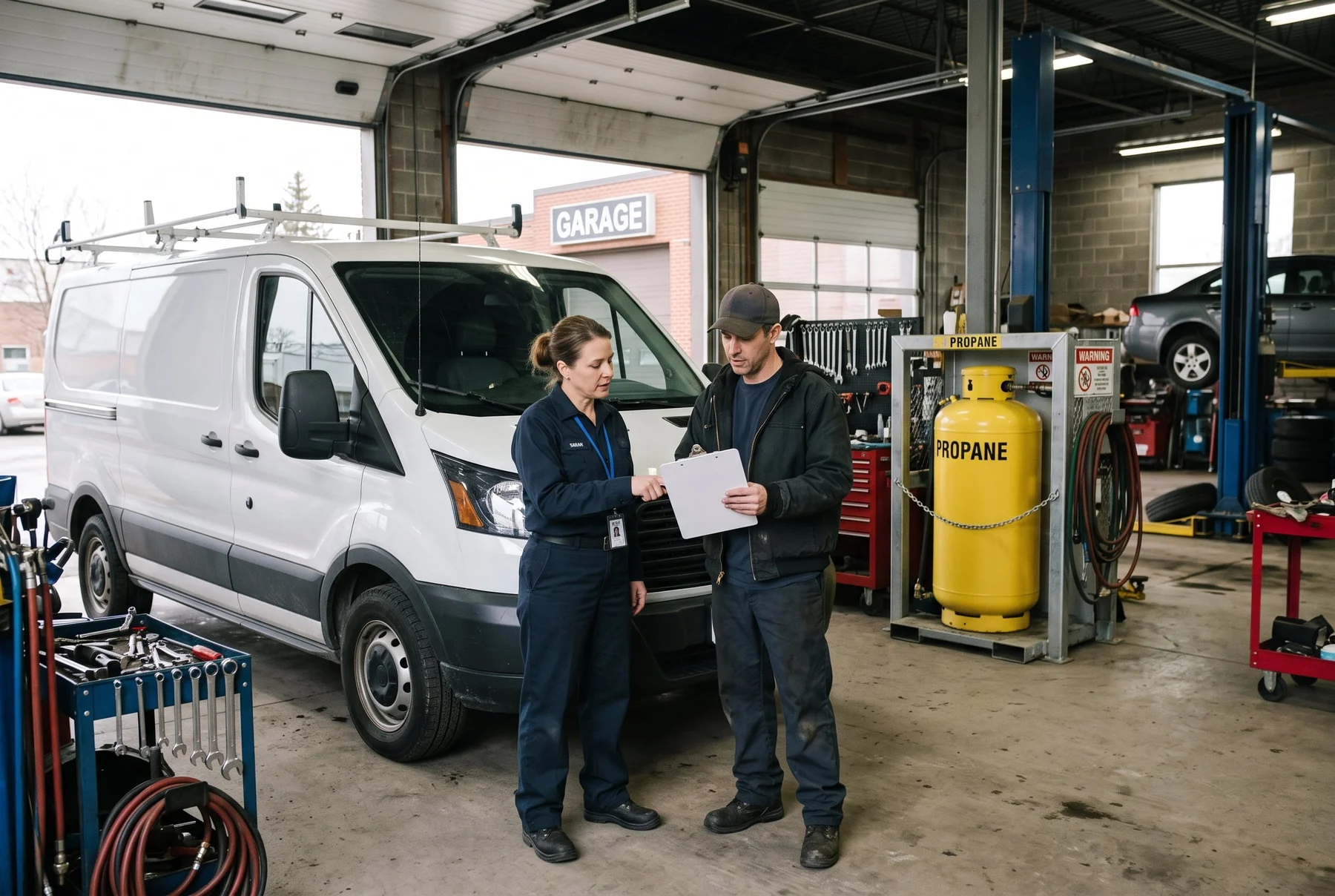
Ask the workshop which equipment and calibration it would use for your engine and model year. A written quotation should make labour, tank configuration, any inspection and aftercare clear. Ask what space is occupied and how the vehicle’s normal use could be affected. For a work van, load practicality may matter as much as the fuel calculation.
Clarify warranty, maintenance and insurance questions before authorising work. Installation requirements can vary by province and circumstance, and this article is not a certificate of road suitability. A workshop should be able to explain the next technical questions for your specific vehicle. Do not follow generic online fitting instructions or interpret a parts listing as a complete conversion plan.
Map refuelling into the real journey
Find suitable automotive propane refuelling along the routes you use. Check the service is intended for road vehicles, whether access suits your hours and how you would handle a disrupted stop. Include the extra distance and time of any detour. A large pump-price difference is less useful when obtaining the fuel makes daily work awkward.
Ask whether the proposed system continues to use gasoline at particular times and how that use should be estimated. A simple propane-only calculation may otherwise overstate the fuel saving. Long trips and seasonal patterns deserve separate thought. Availability on one familiar route does not mean a national journey will be equally convenient.
Make your own comparison
Fuel-cost calculator
Editable examples, not market prices or an installer quote. Use separate consumption figures for gasoline and propane.
Run the numbers with unequal consumption
The comparison tool below accepts a consumption value for each fuel. Multiply litres per 100 kilometres by the price per litre to get a fuel cost for that distance. The difference, scaled by annual kilometres, gives a fuel-only annual comparison. Dividing installed cost by a positive annual difference produces a simple payback estimate.
This is arithmetic based on your inputs, not a forecast or a supplier quotation. The starting values are illustrative. If annual fuel costs do not fall, the output explicitly says there is no fuel-cost payback. Even a positive difference leaves out servicing changes, financing, insurance, retained gasoline, time and detours. Add those factors to a separate budget before treating the result as a purchasing decision.
Try the decision when conditions are less favourable
Change the values one at a time. Use fewer annual kilometres, a smaller pump-price gap or higher propane consumption. Note which assumption changes the outcome most. Then ask whether you have strong evidence for that value. This can turn a vague “will it save money?” conversation into a useful request for information.
Contact Kiff Auto with the vehicle details and intended use, and ask whether its current service can address the questions you have recorded. No fixed price, savings percentage, emissions benefit or installation date is claimed here. Keeping the current system can be a reasonable conclusion when compatibility, refuelling or the complete cost does not fit your situation. A useful comparison leaves room for that answer.
The questions worth asking
Three useful answers
Is this an E85 conversion?
No. This offer concerns automotive propane/LPG in Canada. Ethanol E85 is a different fuel and requires different vehicle suitability and equipment.
Can any gasoline vehicle be converted?
Do not assume so. The installer needs to assess the specific model, engine, year, condition and intended use, along with applicable requirements.
Does a positive calculator result guarantee payback?
No. It is a fuel-only estimate from editable assumptions. Installation scope, retained gasoline use, servicing, financing, insurance and refuelling detours can change the result.
Sources & commercial disclosure
Provider information reviewed on 21 September 2026. Check the current provider pages before acting. Practical exercises and calculator assumptions are our own guidance, not promised provider outcomes.
This is advertising content from Chaincutters, operated by 8115311 Canada Inc. (seoplus+). It introduces an external service. Any agreement is with that provider under its terms. Referral parameters identify this site and article; they do not change the destination.