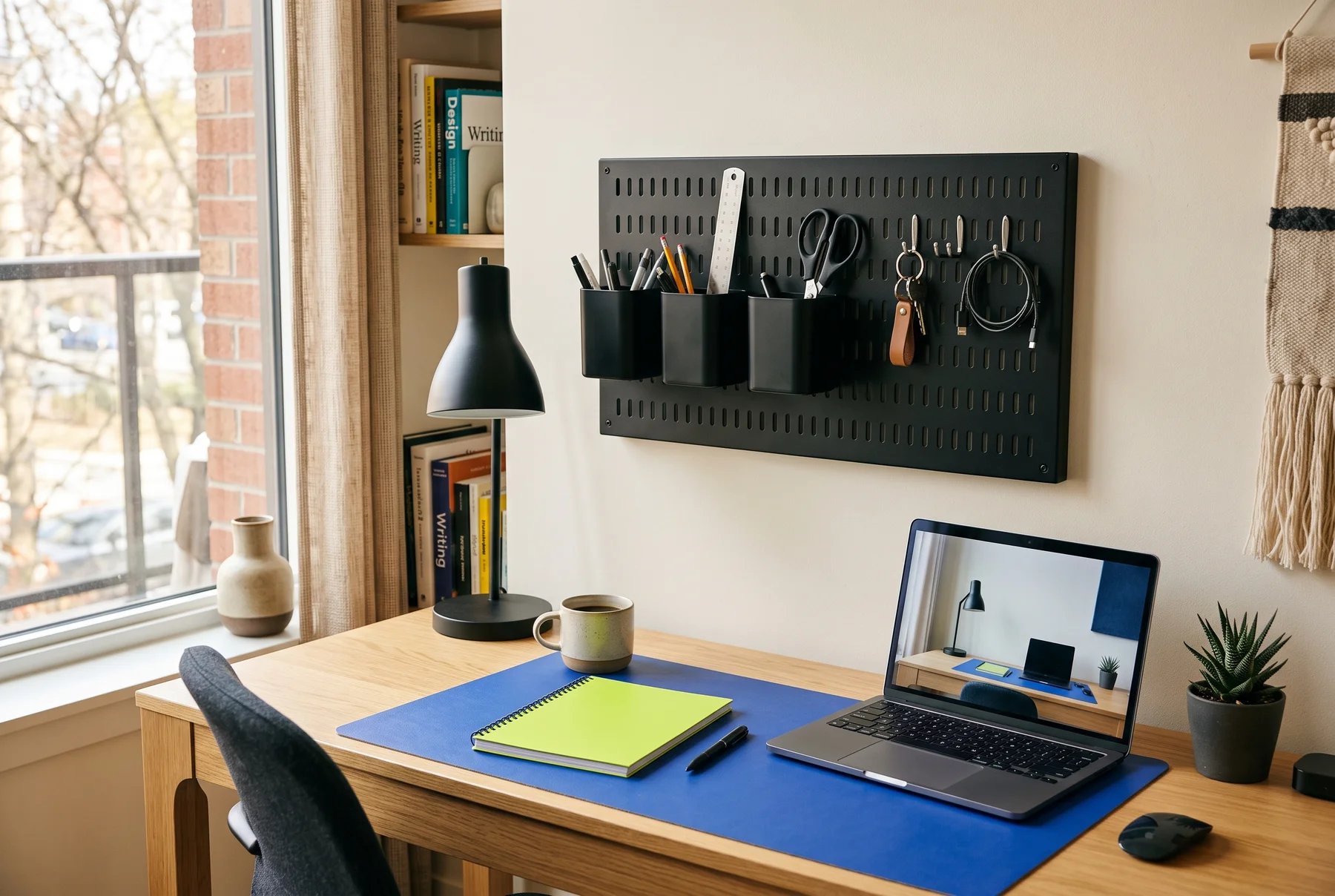
The desk is full. Is the wall doing anything?
A crowded desktop often contains tools that need to stay nearby but do not need to lie flat: scissors, keys, notes and small accessories. Moving them into visible wall storage can free the working area without hiding them in a drawer. The question is whether you can create a useful arrangement in the space you have, with an installation that suits the wall or furniture.
IKEA Canada lists a black SKÅDIS pegboard measuring 36 × 56 cm, article 805.343.72. It is part of a modular system of boards and accessories. The listing includes a wall-mounting rail, while suitable wall screws are sold separately. That distinction matters: the board price is not automatically the complete cost of a finished, safely mounted organisation system.
Inventory the small things first
Put the items you want to organise on a table. Separate the tools you reach for every day from occasional supplies and things you could store elsewhere. Measure awkward objects and think about how you will remove them from a hook or container. A board can look spacious when empty and feel crowded once each item needs room to be lifted out.
Sketch a loose arrangement using the actual board dimensions. Keep frequently used items within comfortable reach and avoid placing a protruding object where it will obstruct a chair, door or screen. The aim is not to reproduce a showroom arrangement. It is to make your own sequence of work easier to begin and easier to put away.
Choose a mounting route before choosing accessories
The current IKEA description allows wall installation or, with separately sold connectors, attachment to a desk or wardrobe side. These are different arrangements with different practical constraints. Read the relevant assembly instructions and check the suitability of the supporting surface. If you rent, consider what installation is permitted before committing to holes or fittings.
IKEA warns that the product must be securely anchored with suitable screws and plugs and advises professional help when uncertain. Follow that guidance. The convenience of modular hooks does not remove the importance of the support behind the board. Do not improvise a mounting method from a social-media photograph or assume that hardware for another wall type is appropriate.
Build a system around retrieval
Choose the accessories that suit the objects rather than filling every slot. A cup may serve pens; a hook may suit keys; a shelf may be useful for something that needs a flat base. Check the intended accessories and their instructions. An inexpensive board can become a larger purchase once you add the pieces required for your layout.
Leave some room to change the arrangement after using it. If a tool is awkward to remove, move it instead of accepting a daily annoyance for the sake of symmetry. Keep the setup focused: a board intended for desk essentials does not need to become storage for the entire household. Visual access is a benefit only when the useful items remain easy to identify.
Know when a drawer is the better answer
Open storage puts its contents in view. That can help with quick retrieval, but it may not suit private paperwork, fragile objects or supplies that require restricted access. A drawer or closed box can still be the right complement. You can combine visible everyday tools with less visible reserve supplies rather than expecting one system to perform every storage job.
Consider cleaning and the background behind video calls if the board is near a work desk. A compact arrangement is easier to inspect and reset. The listed board’s material is fibreboard with an acrylic-painted finish; use the manufacturer’s care instructions rather than treating it as an industrial metal tool panel. Its appearance should not encourage loading or handling beyond its intended use.
Price the finished arrangement
Check the exact black 36 × 56 cm board on IKEA Canada, then list each accessory and installation component you would need. Confirm current local stock, collection or delivery options and the assembly information. Do not assume that every object shown in the product photography is included with the board.
Before ordering, ask whether you can name the items, the mounting location and the hardware plan. If the answer is yes, the system gives you a concrete way to test vertical storage. If the answer is no, begin with a smaller sorting exercise. The result you want is a working surface you can use comfortably, not a larger display of things that still have no clear role.
The questions worth asking
Three useful answers
Does the product price include everything in the photo?
Not necessarily. Read the current listing and list any separate accessories or installation parts before comparing the total.
Will it fit my room?
Measure the product location, access and any moving doors or furniture. Use the exact current dimensions, not an impression from a styled photograph.
Is availability the same across Canada?
No. Store stock, collection and delivery options depend on the selected location and may change. Check the retailer directly.
Sources & commercial disclosure
Provider information reviewed on 21 September 2026. Check the current provider pages before acting. Practical exercises and calculator assumptions are our own guidance, not promised provider outcomes.
This is advertising content from Chaincutters, operated by 8115311 Canada Inc. (seoplus+). It introduces an external service. Any agreement is with that provider under its terms. Referral parameters identify this site and article; they do not change the destination.